A sharp bang from the garage
A spring can release stored energy with a loud report. Look from a safe distance for a gap in a torsion spring or a separated extension spring.
Serving Bonifay, Florida
Garage door spring service in Bonifay
Get a broken torsion or extension spring diagnosed and replaced so the door can move safely again.
Broken spring guidance
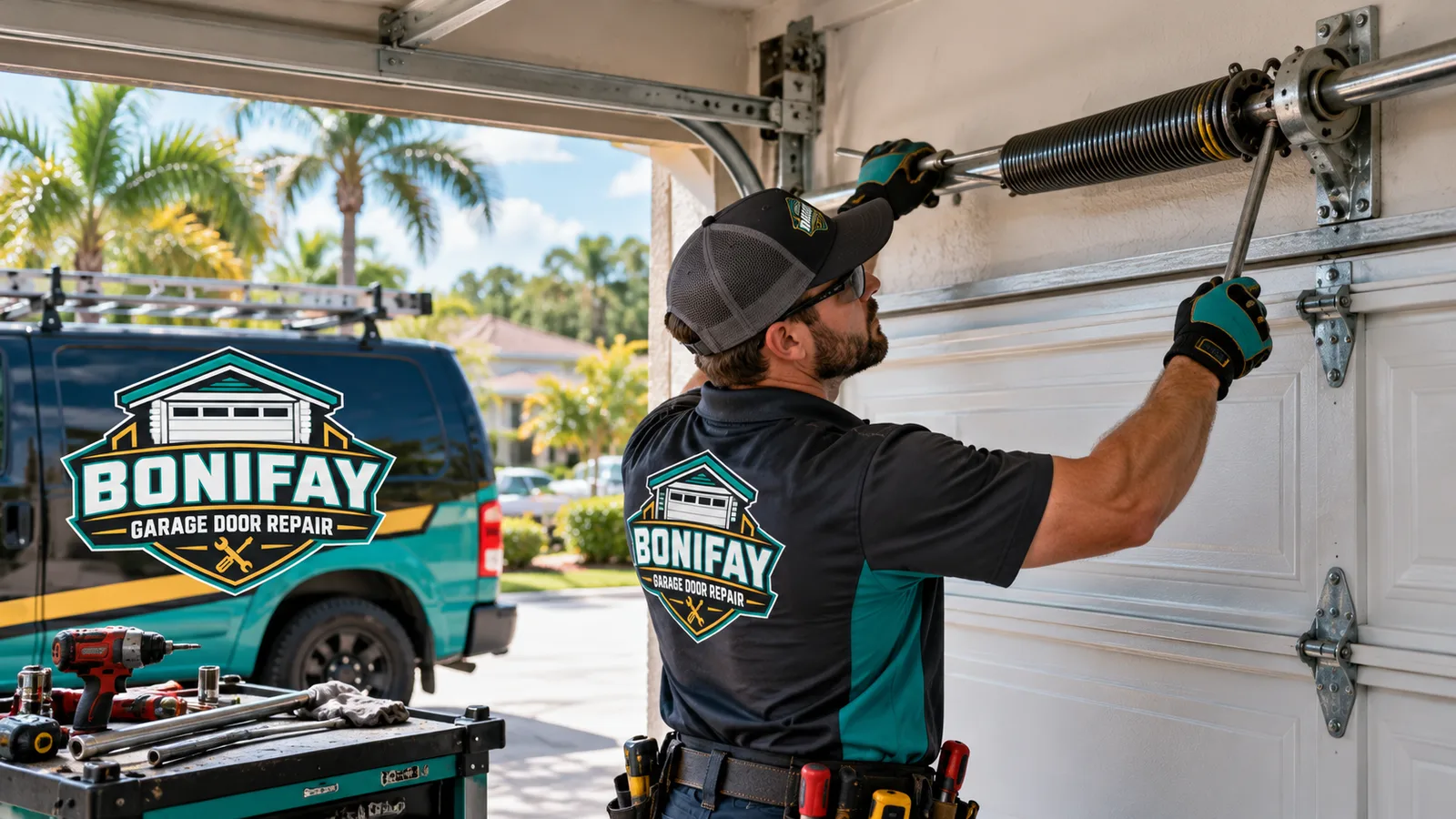
A loud bang followed by a garage door that feels unusually heavy often points to a broken spring. We provide garage door spring repair in Bonifay, FL, for residential torsion and extension spring systems. First, keep the door closed, stop using the opener, and arrange an inspection.
Springs carry much of the door's weight. When one breaks, the opener may strain, the top panel may bend, or the door may rise unevenly. Do not keep pressing the wall control, and do not pull the emergency-release cord while the door is open. A door without proper spring support can fall quickly. Keep people, pets, and vehicles clear until the system has been checked.
Spring failure is a focused repair, but the technician still needs to examine the connected hardware. That includes the cables, drums, center bearing, end bearing plates, rollers, tracks, and opener attachment. If the problem turns out to involve another component, garage door repair in Bonifay can address the broader operating issue.
Spring system diagnosis
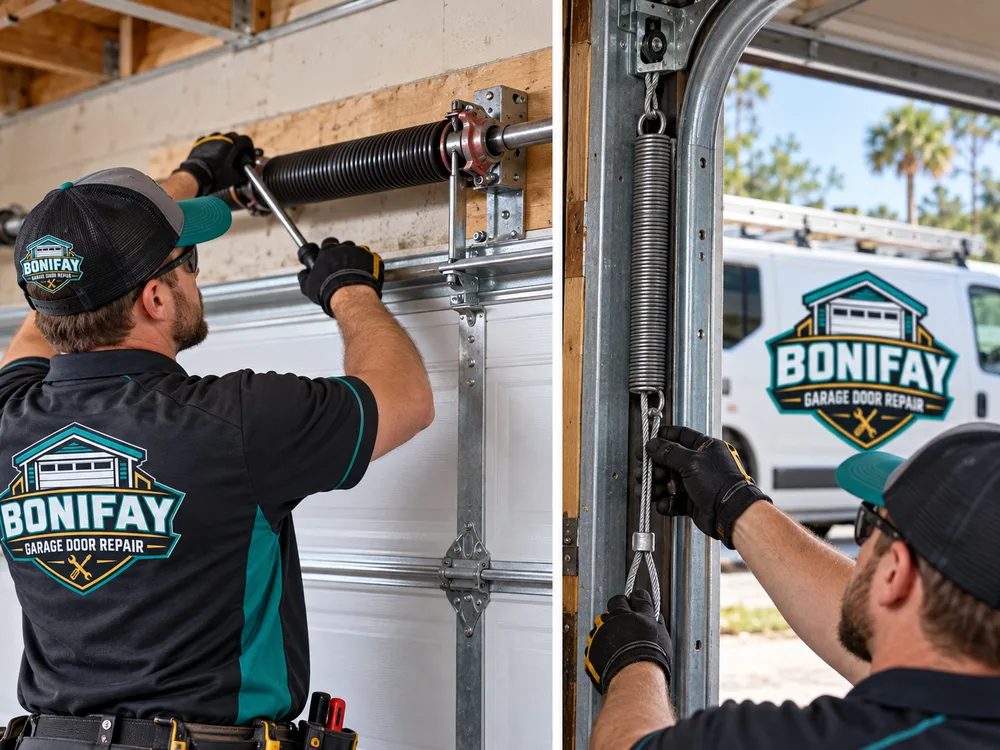
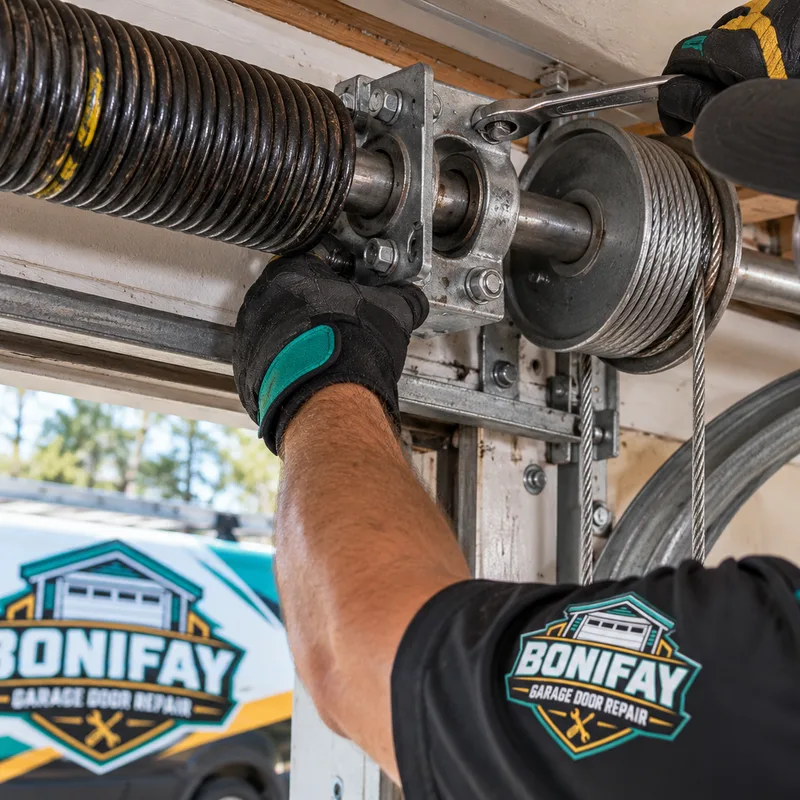
A torsion spring sits on a shaft above the door opening. Cables wind onto drums at each end of that shaft as the door rises. A visible gap in the spring coil usually indicates a break. Some wider or heavier doors use two torsion springs, and both springs must be assessed for size, condition, and balance.
Extension springs run alongside the horizontal tracks and stretch as the door closes. They work with pulleys and lift cables, and properly configured systems use safety cables through the springs. A separated spring, loose pulley, hanging cable, or crooked door calls for professional attention.
Replacement is not based on appearance alone. Spring selection depends on the door's actual weight, height, track arrangement, drum type, and spring dimensions. Wire diameter, inside diameter, and coil length matter on torsion systems. Matching the spring to the door allows the repaired door to remain near waist height when tested manually instead of dropping or shooting upward.
Warning signs
A spring can release stored energy with a loud report. Look from a safe distance for a gap in a torsion spring or a separated extension spring.
The motor may hum or the trolley may move while the door barely lifts. Stop operating it to avoid extra load on the opener and door panels.
A correctly balanced door should not require extreme force to move by hand. Added weight after a bang is a strong sign that spring assistance has been lost.
A cable may have left a drum, or one side of an extension system may no longer be supporting the door. Continued movement can wedge rollers in the tracks.
Torsion springs are wound tightly when intact. A distinct opening in the coil often marks the point where the steel broke.
A broken spring can remove cable tension. Loose cables should be inspected rather than placed back on the drum by hand.
Diagnosis through testing
The repair process identifies the failure, matches the spring to the door, controls stored tension, and verifies balanced operation.
We check whether the spring is broken and looks for related cable, drum, pulley, bearing, track, or panel damage. This prevents a different fault from being treated as a spring problem.
The door is evaluated by weight and configuration. The spring dimensions and hardware arrangement are recorded so the replacement provides the right lifting force rather than relying on color alone.
The door and shaft are controlled before hardware is loosened. Torsion springs require proper winding bars; improvised screwdrivers or other tools can slip under load.
The replacement spring is fitted, cables are seated correctly, and the spring is tensioned for the door. On paired systems, replacing both springs may be recommended when they have shared the same service history.
The door is moved manually to check balance at several positions. The opener is reconnected only after the door travels evenly, the cables stay on their drums or pulleys, and the hardware is checked.
Stored-energy safety
Garage door springs store enough energy to lift a door that may weigh hundreds of pounds. Torsion springs must be wound and unwound with correctly sized solid winding bars while the shaft and door are secured. Extension springs can recoil if they are disconnected without controlling the load. Both systems place hands close to brackets, cables, and moving parts.
Disconnecting the opener does not make a broken-spring door light. It only separates the motor from the door. Lifting the door without spring support can cause it to fall, and clamping or pulling on a cable can move the other side unexpectedly.
Northwest Florida's humid, rainy climate can contribute to surface corrosion on exposed steel hardware. Corrosion does not prove that a spring is about to break, but rust, pitting, frayed cables, noisy bearings, or loose fasteners deserve attention during inspection. These conditions are checked alongside spring size and door balance rather than treated with lubricant as a substitute for repair.
If the door is stuck, crooked, or unusually heavy, leave it closed and arrange a spring-system inspection before operating it again.
CALL NOW: (850) 373-4233Common questions
Review common questions about broken springs, door operation, replacement, and connected hardware.
It is safest to leave a garage door closed when a spring is broken. The door may be too heavy to control, and an opener can damage its motor, trolley, or the top door panel while trying to lift the unsupported weight. If a vehicle is trapped, tell us when arranging service so the situation can be assessed without suggesting unsafe lifting.
Both springs are often replaced when a two-spring system has a shared service history, but that depends on the door and the condition of the remaining spring. A matched pair shares the load and supports consistent balance. The technician should identify the installed springs, weigh or otherwise verify the door requirements, and explain the appropriate repair before work starts.
A straightforward residential spring replacement can often be completed in one service visit, although the actual time depends on the system and any related damage. Resetting displaced cables, replacing worn bearings, or correcting an incorrect prior spring installation adds work. We confirm the repair scope after inspecting the door.
A torsion spring is mounted on a metal shaft above the door opening, while extension springs run beside the horizontal tracks. The two systems use different hardware and replacement methods. Do not touch either system to identify it; the spring location is usually visible while standing inside the garage at a safe distance from the closed door.
Early failure can result from an incorrectly sized spring, excessive door weight, corrosion, damaged bearings, poor balance, or a spring with an unsuitable cycle rating. The repair should include checking the door's weight and movement rather than copying an existing spring that may already be wrong. Bonifay's humid conditions also make inspection for corrosion worthwhile.
Yes, repeatedly running an opener against a broken spring can overload the motor or damage the trolley, rail, arm, or top door panel. The opener is designed to move a properly balanced door, not lift the door's full weight. Stop using it if the door became heavy, moved only a few inches, or failed immediately after a loud bang.
No, lubricant cannot repair cracked steel, restore a broken spring, or correct the wrong spring size. A suitable garage-door lubricant may reduce friction at designated metal contact points, but grinding, uneven travel, rust pitting, or loss of balance requires inspection. Avoid putting lubricant on tracks as a cure for a door that binds or hangs crooked.
Arrange spring service
Tell us what happened, whether the door is open or closed, and what type of spring you can see. You will have a clearer repair scope before the door is put back into service.